Hibernator
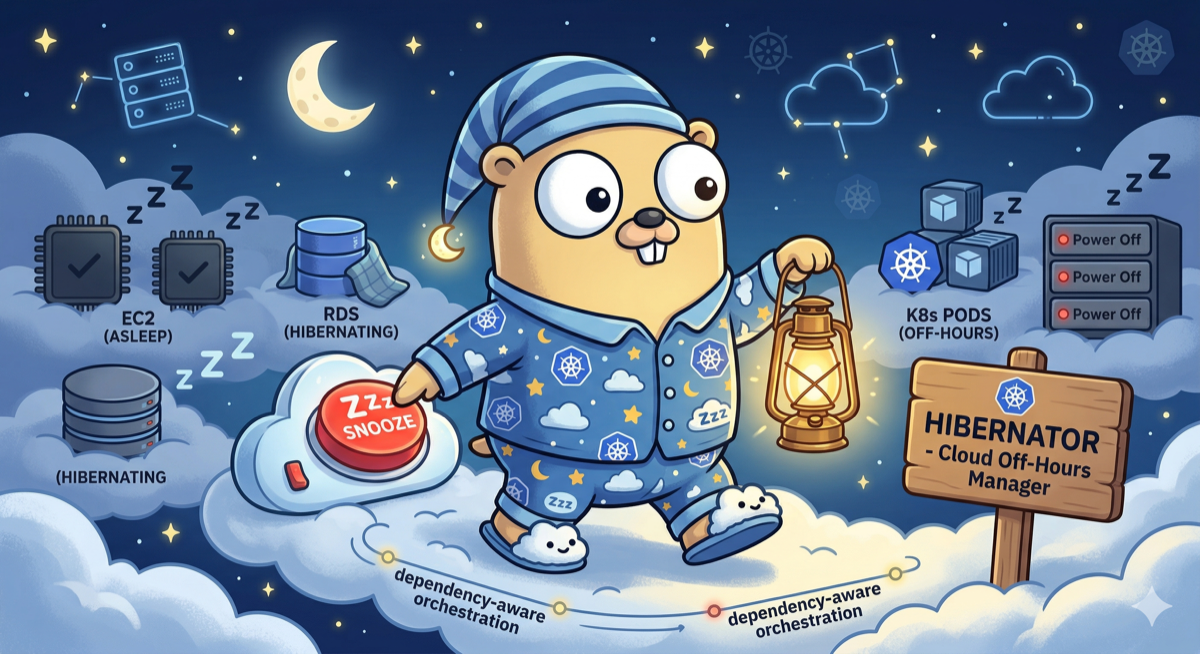
Declarative Kubernetes operator for suspending and restoring cloud infrastructure during off-hours.
What is Hibernator?
Hibernator is a Kubernetes operator that provides centralized, declarative management for suspending and restoring cloud resources during user-defined off-hours. It extends beyond Kubernetes to manage heterogeneous cloud infrastructure (EKS, RDS, EC2, and more) with dependency-aware orchestration and auditable execution.
Key Capabilities
- Timezone-aware scheduling with start/end times and day-of-week patterns
- Schedule exceptions with an on-demand schedule override (extend, suspend, replace)
- Dependency orchestration using DAG, Staged, Parallel, or Sequential strategies
- Pluggable executor model for AWS (EKS, RDS, EC2, Karpenter)
- Isolated runner jobs with scoped RBAC, IRSA, and projected ServiceAccount tokens
- Real-time progress streaming via gRPC or HTTP webhooks between runners and control plane
- Event-driven notifications via Slack, Telegram, or generic webhooks on lifecycle events
- Durable restore metadata persisted in ConfigMaps for safe recovery
Why Hibernator?
Problem: Teams running non-production environments (DEV/STG) waste resources during off-hours. Ad-hoc scripts lack coordination, auditability, and safe restore semantics when dealing with dependencies across Kubernetes clusters, databases, and compute instances.
Solution: Hibernator provides intent-driven infrastructure suspension with:
- Declarative
HibernatePlanCRDs defining what to suspend, not how - Controller-managed dependency resolution preventing race conditions
- Central status ledger with execution history, logs, and restore artifact references
- GitOps-friendly configuration with validation webhooks
Quick Links
-
Install and configure Hibernator in minutes.
-
Understand the architecture and core resources.
-
Step-by-step guides for common operations.
-
Complete CRD field documentation.